FORM · COLOUR · VOICE
Every letter.
Your own voice.
Basic knowledge, forms and techniques in diagrams and short points.
LetterformsTechniquesPractice
01 / KNOW THE FORMS
Understand the form.
Then find your rhythm.
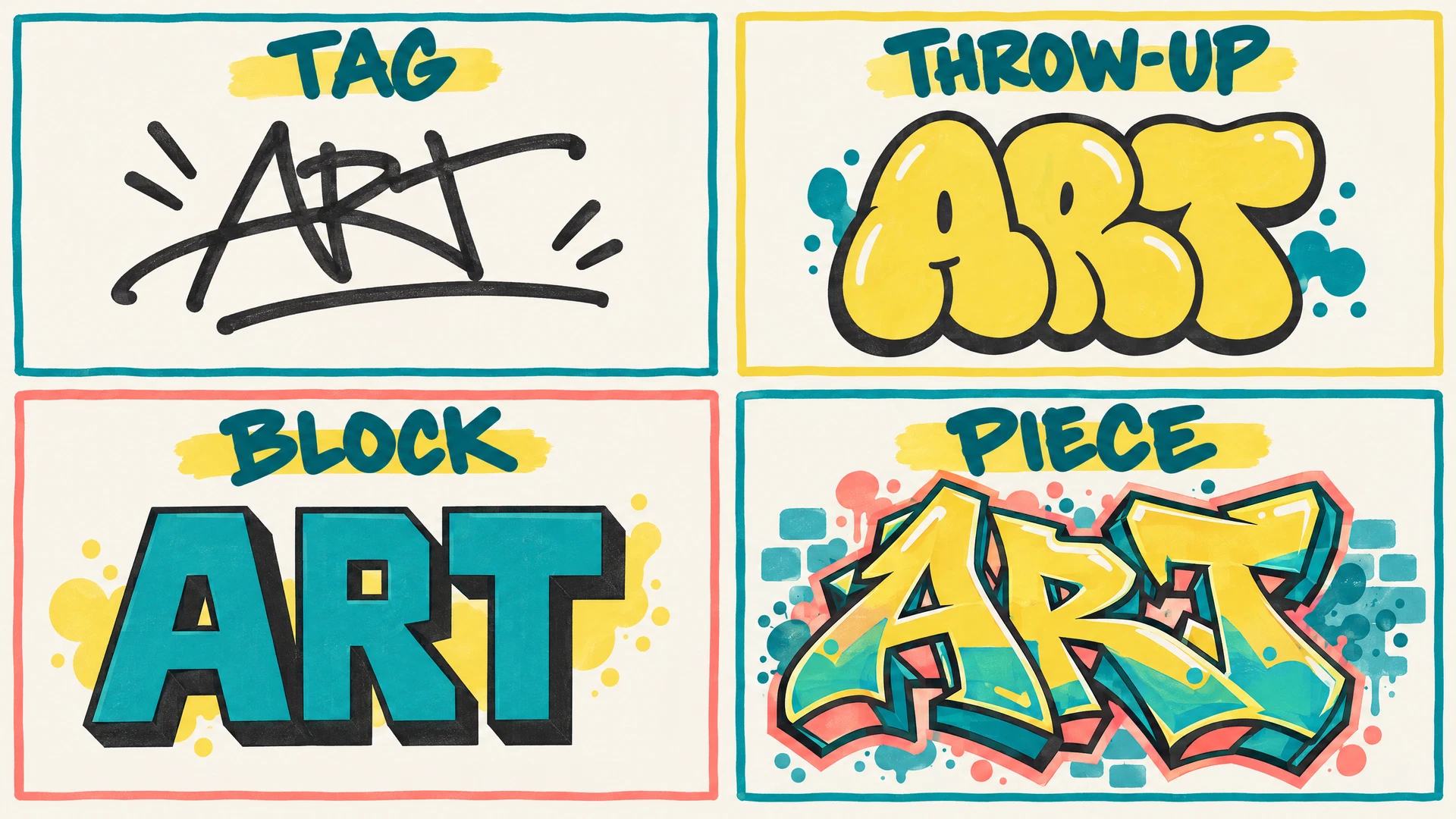
| Type | Key idea / purpose | Keep in mind |
|---|---|---|
| Tag | Signature | Build a name through strokes, connections and rhythm. | Practise on paper first; this is not permission to tag anywhere. |
| Throw-up | Bubble letters | Larger, simplified letters, often with fill and outline. | Keep outlines, spacing and counters clear. |
| Block | Basic geometric letters | Practise structure and spacing with clear geometric forms. | A form exercise, not a fixed historical stage. |
| Piece | Finished work | Combine letters, colour, outline and background. | A finished work, not one exclusive lettering style. |
Swipe the table sideways on mobile ↔
02 / PRACTISE WITH CARE
From sketch to work.
Take care at each step.

Before spraying, confirm permission, ventilation, protection and product labels. Do not practise on unauthorized walls.
Check safety & cap types first ↗03 / SMALL THINGS THAT MATTER
Forms and technique.
Start with four ideas.
| Type | Key idea / purpose | Keep in mind |
|---|---|---|
| Structure & space | Sketch the skeleton; keep letter spacing and internal space. | Establish readability before adding decoration. |
| Fill & layers | Choose a main colour, then arrange areas and transitions. | More colours do not necessarily improve composition. |
| Outline & edges | Connect forms with outlines and a clear hierarchy. | Do not give every detail the same weight. |
| Light, shade & background | Keep a consistent light direction; let the background support the subject. | Effects should not overwhelm letters and the story. |
Swipe the table sideways on mobile ↔
These are introductory prompts, not a fixed schedule, completion guarantee or new course price.
LOOK & PRACTISE / OBSERVATION
Notice line and space.
Then colour and story.

An observation prompt, not a fixed curriculum or the only way to create.
Lettering and artwork concepts refer to the existing street-art course and cited history sources. These techniques are introductory prompts.