
SPRAY SMART / BEGINNER GUIDE
Know your tools.
Create with care.
Safety, paint and cap types: the key points in short tables.
SafetyTypesTest spray
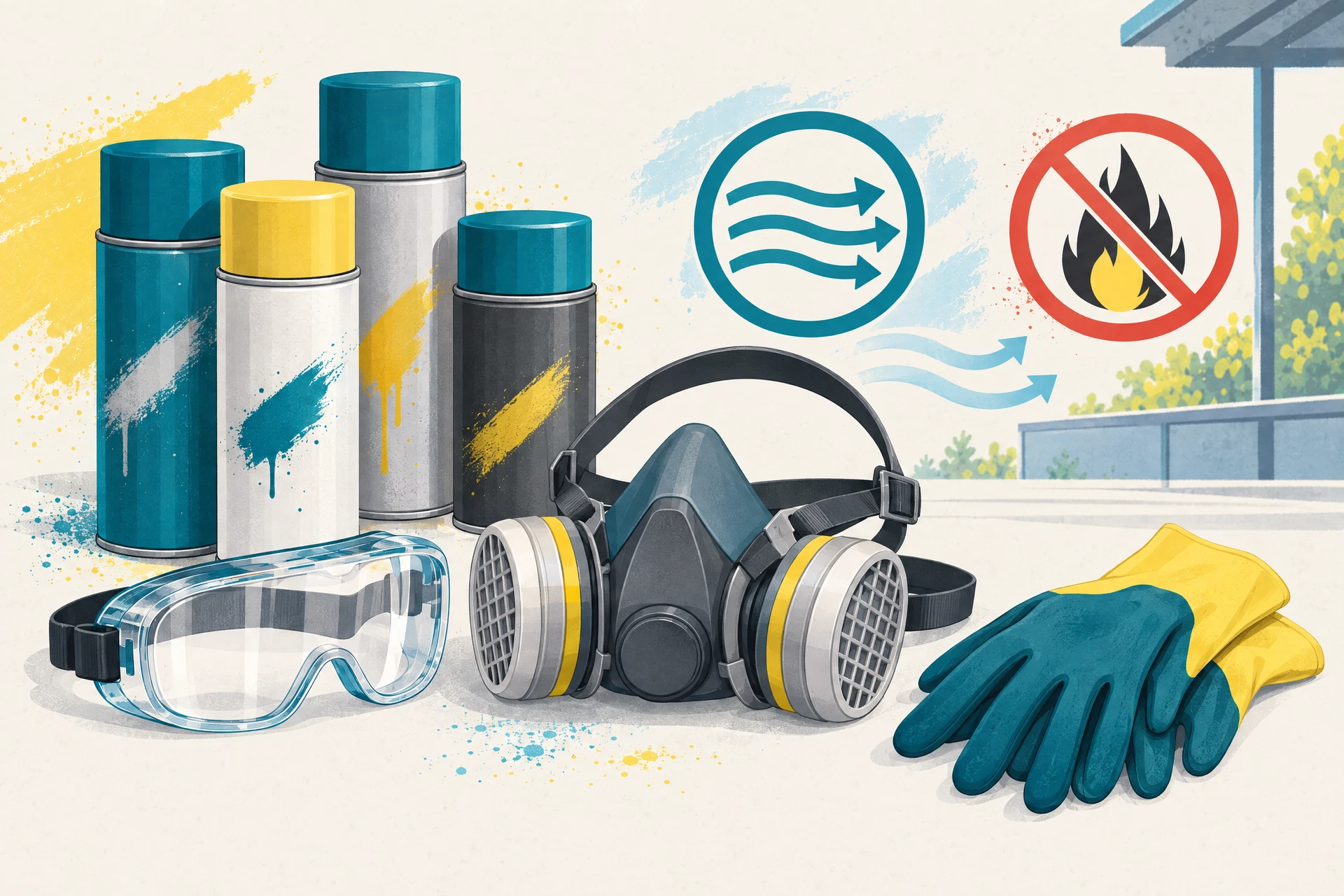
01 / SAFETY FIRST
Make safety.
Your first step.
| Risk / area | What to do | What to avoid |
|---|---|---|
| Ventilation & spray mist | Work in a well-ventilated area; avoid drifting mist and inhalation. | Do not assume outdoors or ventilation eliminates inhalation risk. |
| Respiratory protection | Use the product SDS, hazard identification, and risk assessment to select protection for mist and vapor. | Cloth/basic dust masks do not protect against chemical gases or vapors; avoid generic cartridge advice. |
| Eye & hand protection | Choose eye protection and compatible gloves for paint and solvent hazards. | Do not assume any glove material protects against every paint or solvent. |
| Ignition and heat | Keep away from flames, sparks, and heat; no smoking in the activity area. | Do not introduce flames, smoking, or spark-producing equipment in or near the spray area. |
| People and bystanders | Define the work area, keep non-essential people away, and consider outdoor drift and wind direction. | Never spray at people; keep bystanders out until spray and vapor risks are controlled. |
| Permitted venue & supervision | Use a lawful, authorized area; follow label and instructor guidance, with adults modeling and supervising children. | Do not spray outside designated areas or let children operate unsupervised; water-based or age-labelled does not mean harmless. |
Swipe the table sideways on mobile ↔
SDS means Safety Data Sheet. Follow product labels, risk assessment and instructor arrangements.
02 / CHOOSE YOUR PAINT
Know the formula.
Check pressure and purpose.
| Type | Key idea / purpose | Keep in mind |
|---|---|---|
| Water-based aerosol | Use per label; ventilate even low-odor paints. | Never call it non-toxic or assume indoor safety; mist remains an inhalation hazard. |
| Solvent-based aerosol | Check the product SDS; control exposure and ignition sources as directed. | Hazards vary; an ordinary mask is not a substitute for suitable respiratory protection. |
| Low-pressure series | Slower output aids control for details and effects. | Low pressure does not mean low hazard; check cap compatibility. |
| High-pressure series | Faster, higher-volume output suits quicker broad coverage. | No fixed coverage area; practise control and follow cap guidance. |
Swipe the table sideways on mobile ↔
- Water-/solvent-based refers to formula; high/low pressure refers to product behaviour. These dimensions overlap.
- Low odour, low pressure or water-based does not mean hazard-free.
03 / CAP TYPES
One idea.
Different spray patterns.
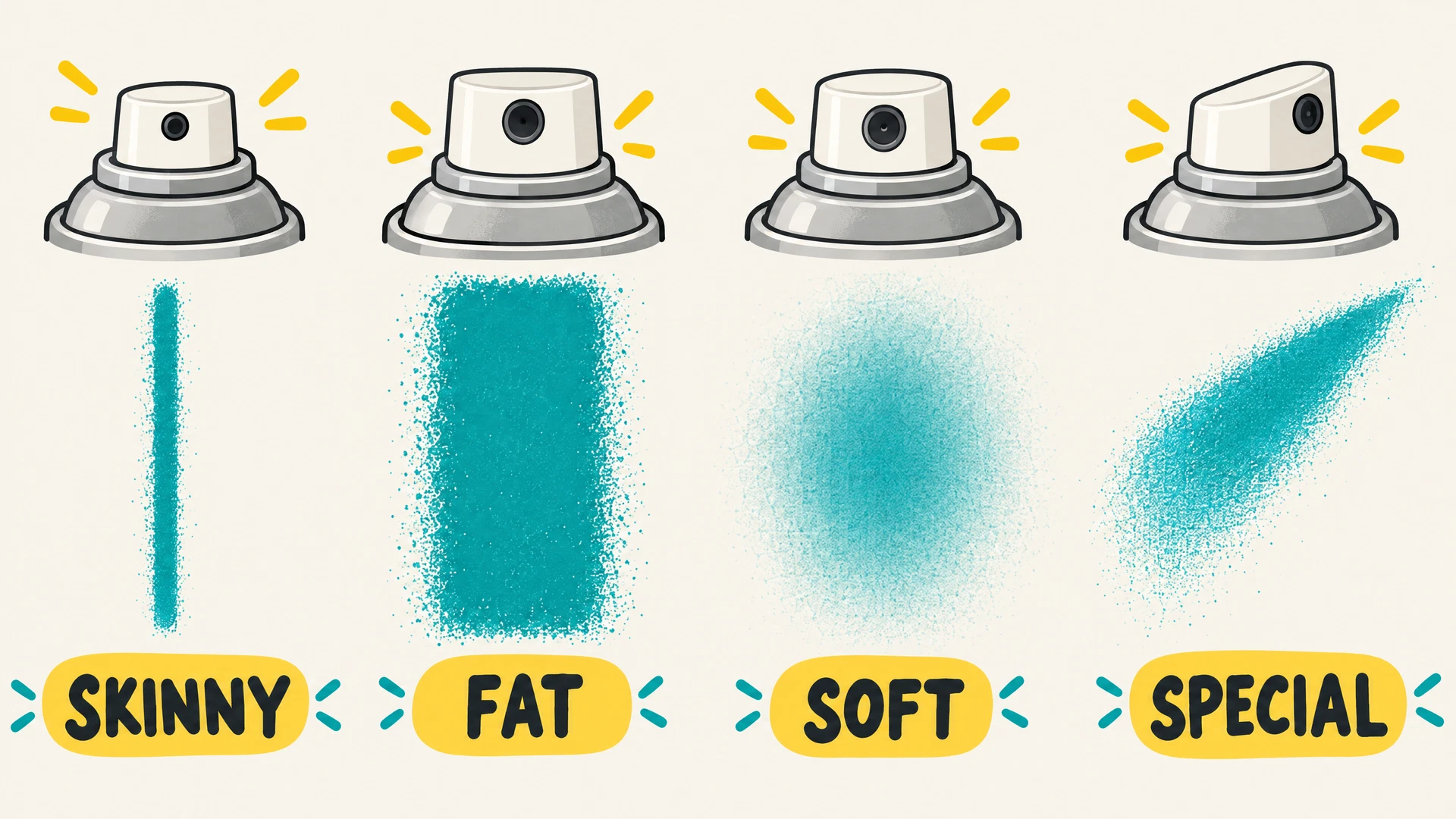
| Type | Key idea / purpose | Keep in mind |
|---|---|---|
| Skinny | Montana Level 1–2 | For fine detail; test on scrap first. | Width varies by distance and can; there is no universal width. |
| Fat | Montana Level 4–6 | For fills or wider output; test distance. | The Level system is designed around Montana GOLD; do not assume universal fit. |
| Soft spray pattern | Level 3 / Level 4 Soft | Try for softer transitions. | Soft describes specific models; pattern and width vary. |
| Special caps | Needle / Flat Jet | Needle for sketchy lines; Flat Jet for flat output. | Not ordinary skinny output; verify can compatibility. |
Swipe the table sideways on mobile ↔
Montana models are manufacturer examples only. Check your can catalogue; do not assume cross-brand compatibility.
04 / FIT · TEST · FINISH
Check, then test.
Finish safely, too.
- Check the fittingSelect by manufacturer model and valve.
- Approved test panelCheck the spray pattern; never aim at people.
- Follow label instructionsDo not assume every can should be inverted to clear.
| Type | Key idea / purpose | Keep in mind |
|---|---|---|
| Nozzle care | Clean the tip as labelled; removable and fixed tips differ. | Do not assume tips are removable/interchangeable or every can should be inverted to clear. |
| Storage & transport | Keep label and SDS instructions; store safely and transport as specified. | Keep away from heat and ignition; do not heat, pierce, or burn, even after use. |
| Leftover cans & waste | Follow the SDS and applicable Hong Kong rules; chemical waste requires licensed collection as specified. | Do not assume empty cans are ordinary rubbish; do not puncture, drain, or wash cans yourself. |
Swipe the table sideways on mobile ↔
Sources & image notes
Spray Painting: Ventilation & PPE
Spray Activity Safety | Fire, People & Venue
Graffiti Spray Paint Types | Beginner Safety Guide
Spray-cap types
Spray Head & Aerosol Can Compatibility
After Spray Painting: Cleanup, Storage & Disposal
Introductory reference, not a site risk assessment. Follow the SDS, manufacturer guidance and professional instruction.